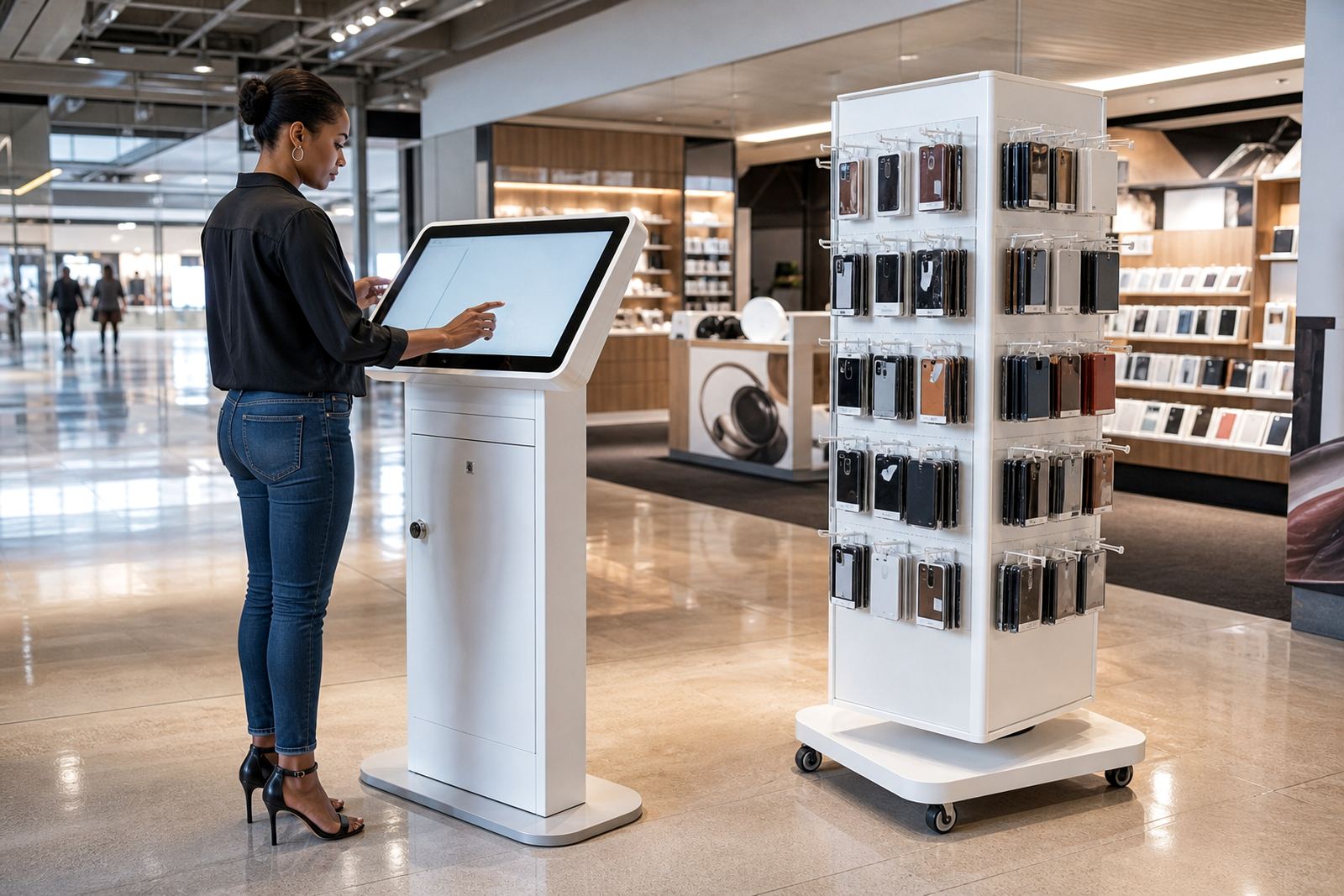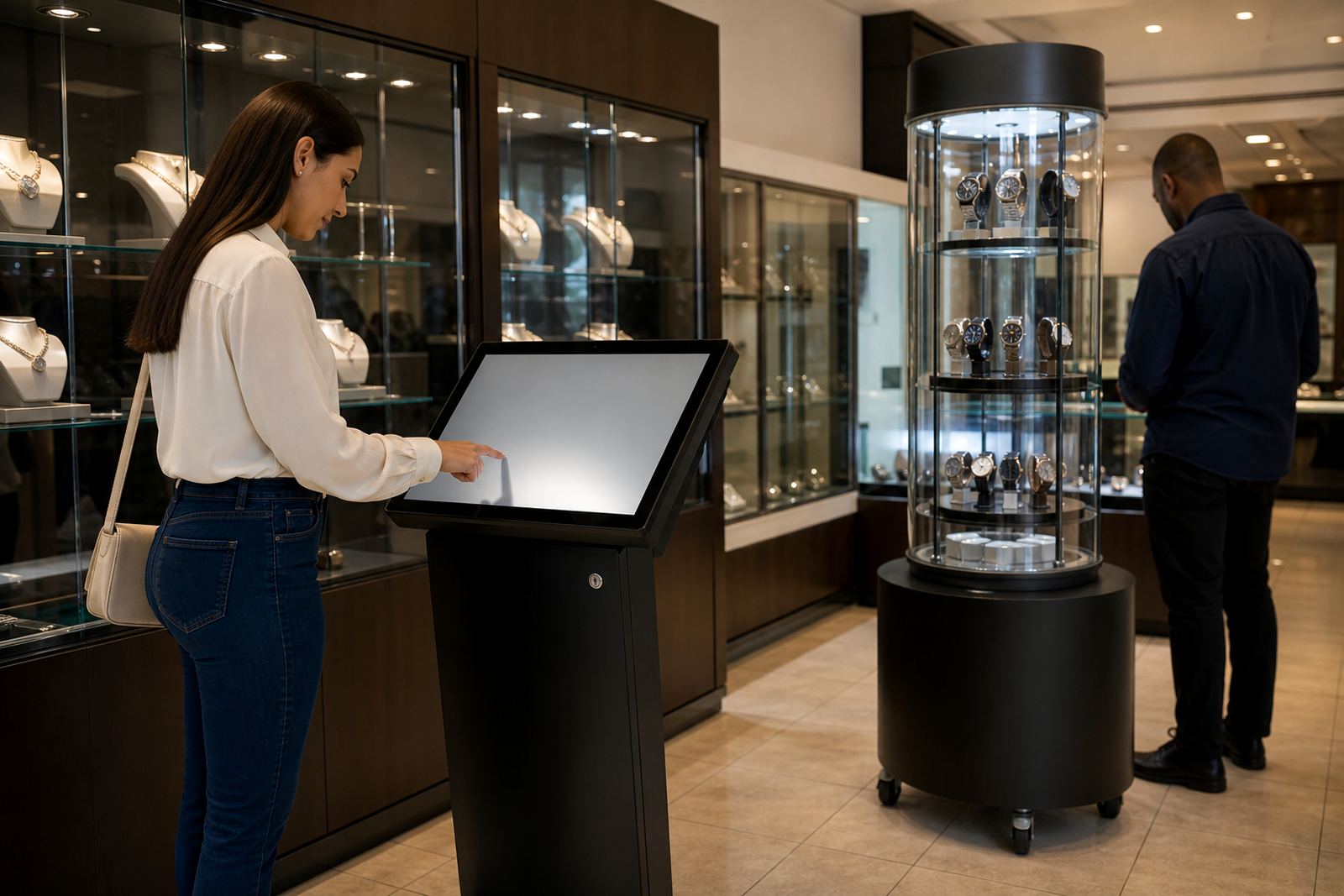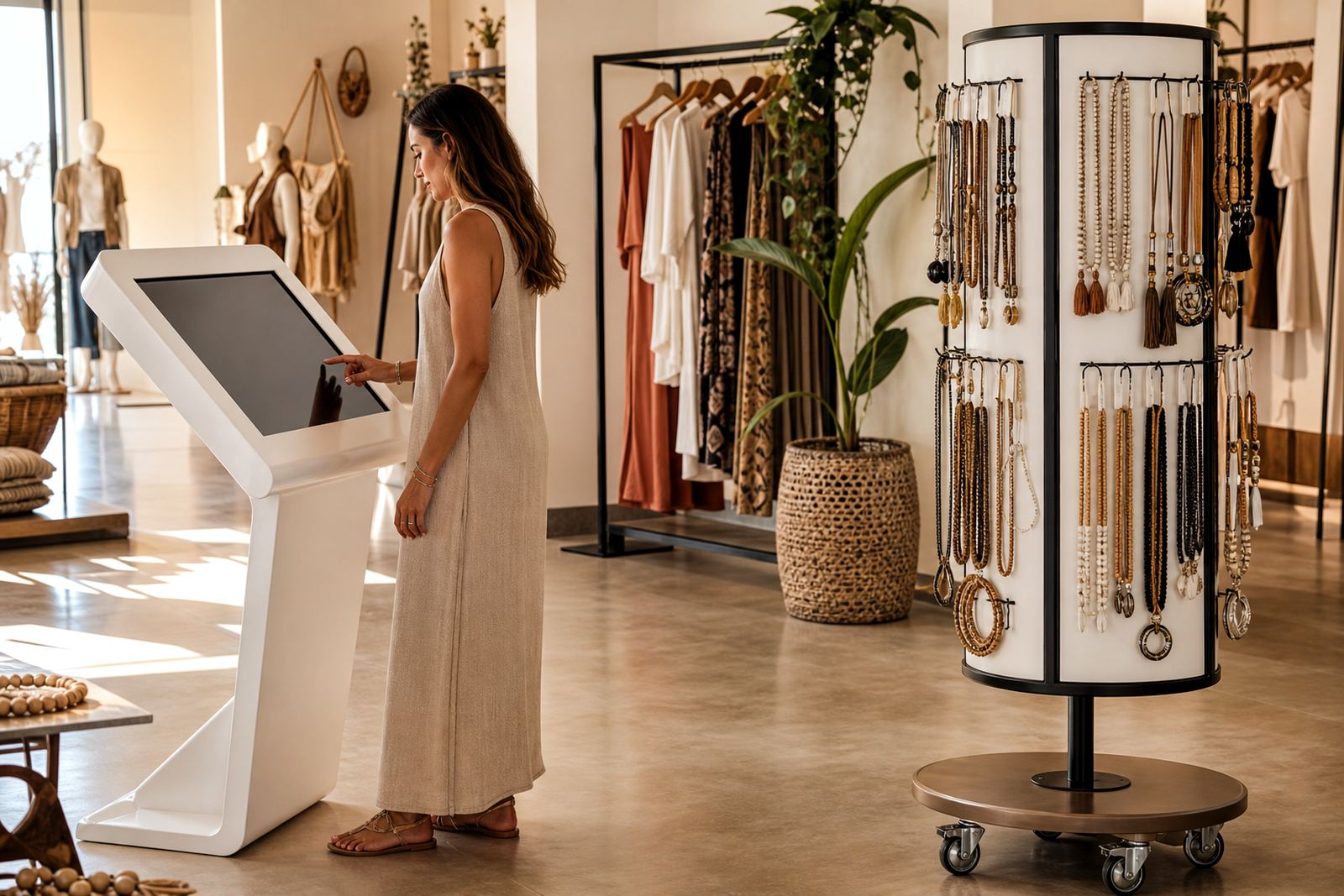

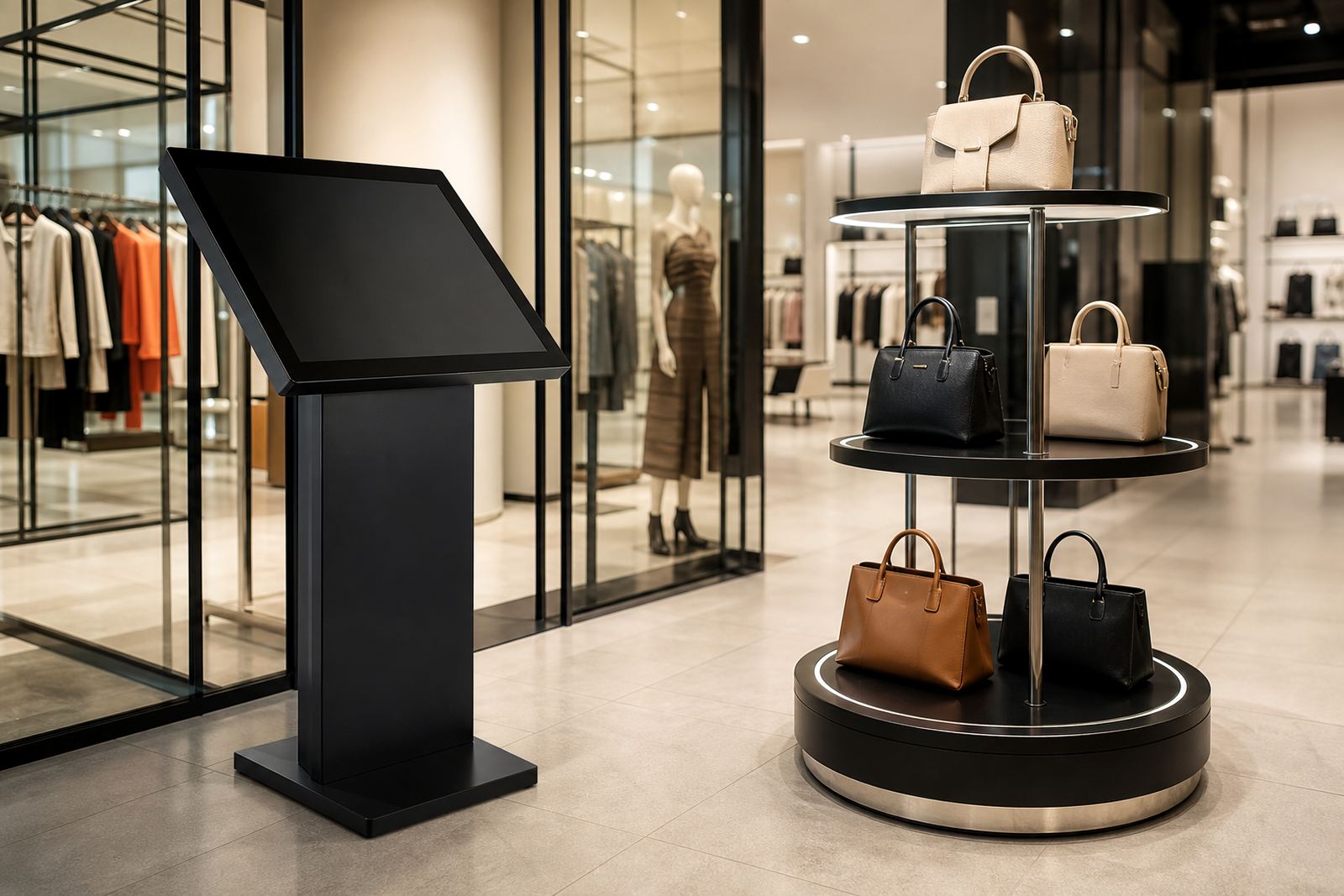
What the Sandton store needed on the floor
The brief came from a premium fashion retailer in Sandton looking to improve how customers browsed collections and add movement near the accessory area. The store wanted a clean in-store journey where shoppers could check product details, view range options, and move from clothing to accessories without waiting for staff at every point.
The main challenge was space. The store had a busy entrance, narrow circulation near fitted lines, and a polished interior finish that could not be cluttered with bulky equipment. It also needed screens and moving display units that would stay presentable through long trading hours, with enough durability for daily use in a Gauteng retail centre where foot traffic is constant.
- Client type: premium fashion retailer
- Town: Sandton, Johannesburg
- Project focus: catalogue browsing and rotating accessory display
- Environment: high-footfall retail floor with tight circulation points
Our site survey and layout plan
We started with a site assessment to measure the available floor area, check power points, and confirm the best positions for customer interaction. That included looking at sight lines from the entrance, natural queue movement, lighting glare on the screens, and how the displays would sit against the existing shop fitting. In Sandton, presentation matters, so the layout had to look intentional from the first step inside.
We then mapped out two customer touchpoints. One focused on catalogue browsing for product details, colours, and sizes. The other supported rotating accessories, giving the team a feature point for handbags, scarves, belts, and seasonal add-ons. The design had to stay elegant but practical, with stable bases and enough clearance for staff to restock during trading hours.
- Power and cabling checked before installation
- Screen placement planned to reduce glare from shop lighting
- Traffic flow kept open for browsing and fitting room movement
- Floor footprint kept compact for premium store presentation
What we supplied and installed
We supplied compact interactive catalogue kiosks with touch-enabled screens, secure housings, and retail-friendly cable management. The kiosks were set up for product browsing, range navigation, and quick access to lookbooks and featured item details. We also installed rotating display stands for accessories, built for regular use and sized to suit the store's premium floor space.
The hardware spec was chosen for a busy indoor retail setting. Displays needed to be bright enough for shopping mall lighting, stable enough for public use, and simple for staff to operate. The rotating stands were fitted for smooth manual rotation, while the kiosks were configured with content loading and software settings to make the customer journey straightforward. We also carried out network integration where required, so the units could work with the store's connectivity and content updates.
- Catalogue kiosks for product browsing and range information
- Rotating accessory stands for handbags, scarves, belts and add-ons
- Content loading for lookbooks, collections, and product highlights
- Software configuration and network integration for store use
Installation timeline and store handover
The project ran over three weeks from survey to handover. Week one covered assessment, measurements, and layout approval. Week two focused on preparation, content setup, and equipment configuration. Week three covered delivery, installation, testing, and staff training. The store was operational after the final checks, with the team able to use the kiosks and displays straight away.
Because retail hours in Sandton are tightly managed, the installation was planned around trading times to keep disruption low. We staged the work in clear steps, protected the finished flooring, and completed final testing before the public busy period. There was also a need to keep the setup neat around the entrance zone, so cable routing and placement were handled carefully. The handover included practical guidance for the store team on day-to-day use and basic care.
- Week 1: site assessment and layout approval
- Week 2: equipment prep, content loading, configuration
- Week 3: delivery installation, testing, and training
- Handover completed with staff ready to use the system immediately
Results for shoppers and staff
The finished setup gave shoppers a clearer way to move through the range, compare product details, and pick up accessory ideas without slowing the store down. Staff could direct customers to the kiosks for catalogue browsing, which reduced repeated questions about sizes, colours, and available styles. The rotating display stands also helped draw attention to smaller items that can often get lost in a busy fashion floor.
For the retailer, the biggest gain was presentation. The store now has a more polished point of interaction, with equipment that supports sales rather than taking up space. It also gave the team a practical way to update information and highlight seasonal items. In a premium fashion environment, that mix of order and movement makes a difference, especially when the store is busy on weekends and after-work shopping hours.
- Improved customer engagement on the floor
- Better product visibility for accessories and featured items
- Less pressure on staff for repeat product queries
- Cleaner premium look across the sales area
What we would do again for another fashion retailer
We would use the same approach for another fashion store in Gauteng or further afield. Start with a proper site assessment, keep the footprint tight, and choose equipment that suits both the shop layout and the pace of retail trading. For fashion stores, the value is in making it easy for customers to browse, compare, and buy without creating clutter.
We would also keep the content structure simple. Fashion retail changes often, so the system needs to support quick updates for seasonal collections, featured accessories, and promotional ranges. In a store with high turnover and changing visual merchandising, that flexibility matters. A good setup should work under pressure, look clean from the entrance, and hold up through daily use with minimal fuss.
- Use compact equipment that suits premium store layouts
- Plan for quick content changes during seasonal shifts
- Keep power, cabling, and traffic flow under control
- Allow room for staff restocking and customer movement
Key facts
| Project type | Fashion retail in-store installation |
|---|---|
| Town | Sandton, Johannesburg |
| Main equipment | Interactive catalogue kiosks and rotating accessory display stands |
| Timeline | 3 weeks from site survey to handover |
| Services used | Site Assessments, Solution Design, Content Loading, Delivery Installation, Software Configuration, Staff Training |
| Use case | Product browsing, range presenting, and accessory merchandising |