
Why jewellery shoppers need closer product viewing
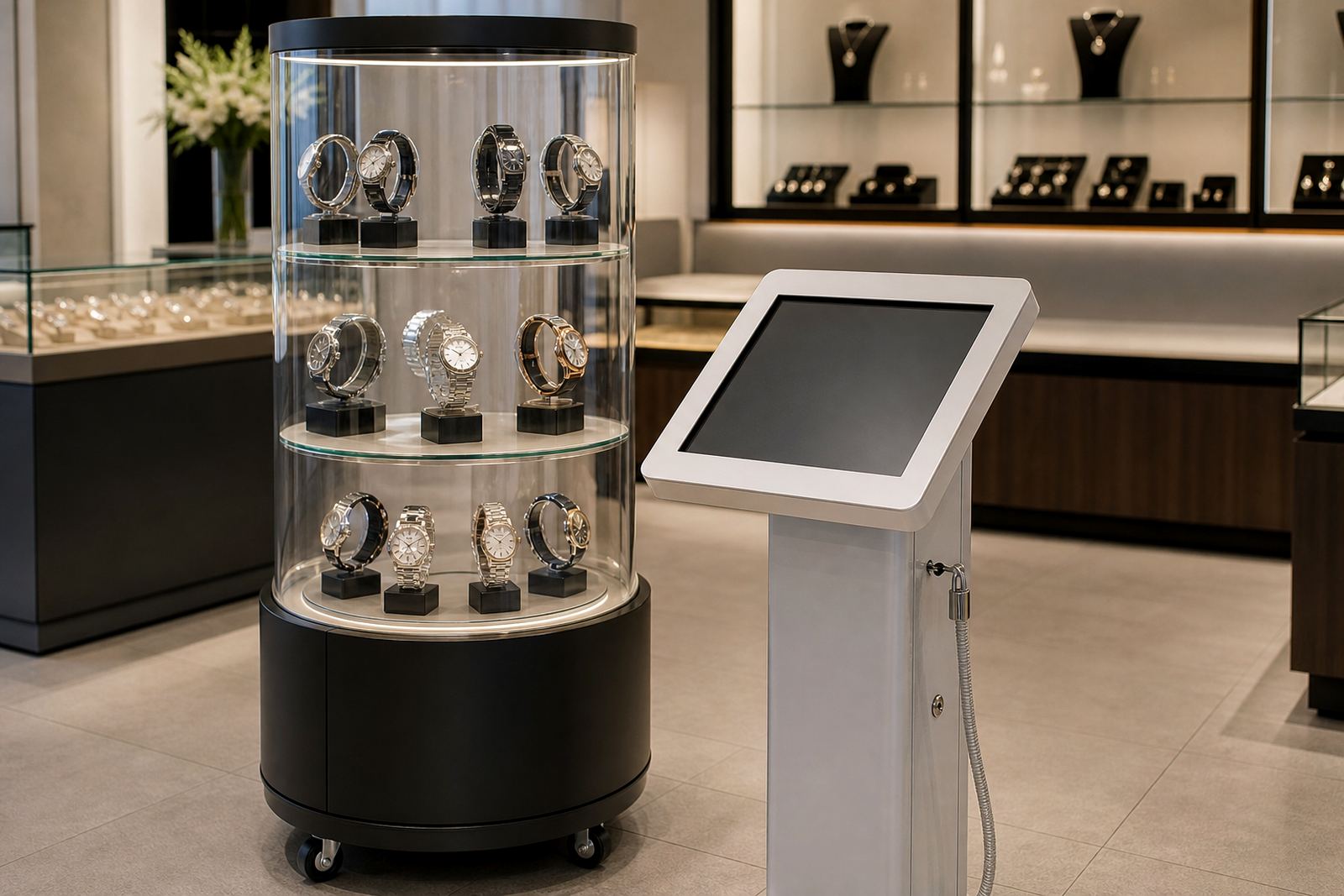
Jewellery is bought with the eye first, then the hand. In a boutique, shoppers want to see the cut, setting, finish and size relationship before they ask questions, so a product display needs to do more than simply hold stock. A compact 360 stand gives a clean full view of rings, watches, pendants and small gift items, while a touchscreen kiosk can show ranges, stone details, care notes and price points without crowding the counter.
For stores in busy centres such as Sandton, Menlyn, Umhlanga and Cavendish, the display has to work under pressure. It must be neat, easy to sanitise, and ready for repeated use throughout the day. In jewellery retail, even a small delay in loading content or a shaky stand can make the whole setup feel cheap. The goal is calm presentation with secure product handling and clear information that helps staff close the sale.
Typical equipment set for a boutique floor
Most jewellery boutiques do not need large units. A practical set usually includes one compact touchscreen kiosk near the entrance or consultation point, plus one or two 360-degree product display stands at the main counter. These can be used for hero items, seasonal ranges, bridal collections or limited edition pieces. Where the store is smaller, a wall side unit or slim pedestal can keep floor space open and still create a strong customer touchpoint.
The equipment set is often planned around power points, counter height, traffic flow and security sightlines. In Midrand and Pretoria stores, we often see retail spaces with tight front windows and deep back areas, so the layout must guide shoppers from the entrance to the display and then into the consultation zone. On the technical side, the system can include local content storage, simple product menus, and a locked housing for safe daily use.
- One compact touchscreen kiosk for product lookup, videos and guided selling
- One or two 360 stands for rings, watches or featured collections
- Lockable housing or fixed mounting for added security
- Simple branding panels in store colours and finishes
- Basic network connection for content updates and reporting
Layout planning that works in real retail space
Good jewellery display planning starts with where customers pause naturally. The best placement is usually just inside the entrance, beside the till point, or close to the consultation chair where staff can explain the collection. The unit should not block movement, and it should never sit where handbags, trolleys or queues can knock into it. For stores with glass fronts, avoid harsh glare from sunlight, because reflection on the screen can make the content hard to read.
If the boutique is in a mall, check the centre rules for power use, floor fixing and any restrictions on wall mounting or visible cabling. In coastal towns like Cape Town and Durban, humidity and salt air can affect exposed fittings, so enclosed components and sensible servicing intervals matter. In Gauteng, load shedding can also interrupt a sales flow, so it helps to plan for quick restart procedures and clean cable management that does not rely on loose adapters.
- Keep the screen visible from the point of entry but not in the main walkway
- Place 360 stands where staff can supervise them without hovering
- Allow space for two customers to view content at once
- Use anti-glare positioning near windows and bright downlights
- Plan for cleaning, cable access and after hours security checks
Content that supports high value sales
Jewellery buyers want reassurance. They need to know what they are looking at, what it costs, and why one piece differs from another. That is where a touchscreen kiosk helps. It can carry product categories, close-up images, care instructions, metal information and styling notes, all in one place. The content should be short and clear, with large text and simple navigation so a customer can use it in seconds.
For promotions, the display can also highlight gifting periods, engagement ranges, anniversary pieces and corporate gifting lines. If the store offers custom orders, the kiosk can show finishing options, turnaround times and how the process works. This keeps staff free to focus on fitting, explaining and upselling, rather than repeating the same details every hour. The content needs regular checking too, because out of date pricing can cause confusion and lost trust.
Common mistakes that weaken the boutique experience
The most common mistake is putting too much on one screen. Jewellery customers are looking at fine details, so a crowded menu with small buttons and too many images just creates friction. Another issue is choosing a stand that is too large for the store. In compact boutiques, a heavy unit can break the visual balance and make the room feel cramped.
We also see stores leave the display exposed to fingerprints, loose charging cables or unstable footing. That is not suitable in a premium environment. Staff training matters too, because the unit should be used as part of the sales process and not treated as a novelty. If no one knows how to change a product page or restart the system, the display will sit there looking impressive but not doing much.
- Too much content on one screen
- Units that are oversized for the floor area
- Poor cable routing and visible adapters
- Weak security around product samples
- No one assigned to update content or check daily operation
Budget ranges for South African jewellery retailers
Budget depends on whether you want a single showroom unit or a full boutique rollout across several branches. For a basic compact touchscreen kiosk with standard setup, many smaller stores work in the region of R35 000 to R75 000 per unit, depending on screen size, enclosure and configuration. A branded 360-degree product display stand can start around R18 000 to R40 000, with pricing moving up if there is custom finish work or additional security features.
For a more complete boutique package with content loading, installation, software configuration and staff training, a realistic project budget can sit between R80 000 and R180 000 for one store. Multi-site rollouts in Johannesburg, Pretoria, Cape Town, Durban and Bloemfontein are usually priced on scale, because delivery, site visits and support planning can be grouped. Preventative servicing and support retainers are worth considering if the equipment will run daily in a high foot traffic shop.
How iTouch 360 supports boutique rollout and aftercare
iTouch 360 works from Midrand and supports retailers across South Africa with site assessments, solution design, custom branding, content loading, delivery installation and software configuration. For jewellery boutiques, that usually means checking the counter plan, confirming power and network needs, and making sure the display supports the way the team actually sells. If the store needs integration with an existing system, the technical setup can be handled as part of the install plan.
Our team, led by Sibusiso Mthembu, works with Lerato Khumalo on operations, Johan van Wyk on technical delivery, and the rest of the support and project team to keep installations on track. From the Midrand showroom to supply areas in Sandton, Centurion, Cape Town and Durban, the focus stays on practical retail use. The result should feel tidy, secure and easy for staff to use day after day, even when trading is busy or the power is off for a stretch.