
Why furniture showrooms use touch kiosks
In a busy furniture showroom, shoppers often want to browse at their own pace. A touchscreen kiosk lets them move through dining sets, sofas, beds and storage ranges without hunting for a catalogue or asking staff for every detail. It also helps when floor space is tight and you cannot display every colour, size or configuration on the shop floor.
For bigger showrooms in Johannesburg, Pretoria, Cape Town, Durban or Bloemfontein, the kiosk works as a guide between the sample piece and the full range. Customers can view finishes, check dimensions and compare options side by side. That reduces pressure on staff and keeps the sales floor moving, especially on month end and weekends when traffic is high.
Many retailers also use the screen for room visualisation. A shopper can see how a sectional sofa, side table or headboard set might look in a real setting before they commit. It is practical for customers who are furnishing a new home, a rental flat or a guesthouse where colour matching matters.
Typical equipment set for a showroom floor
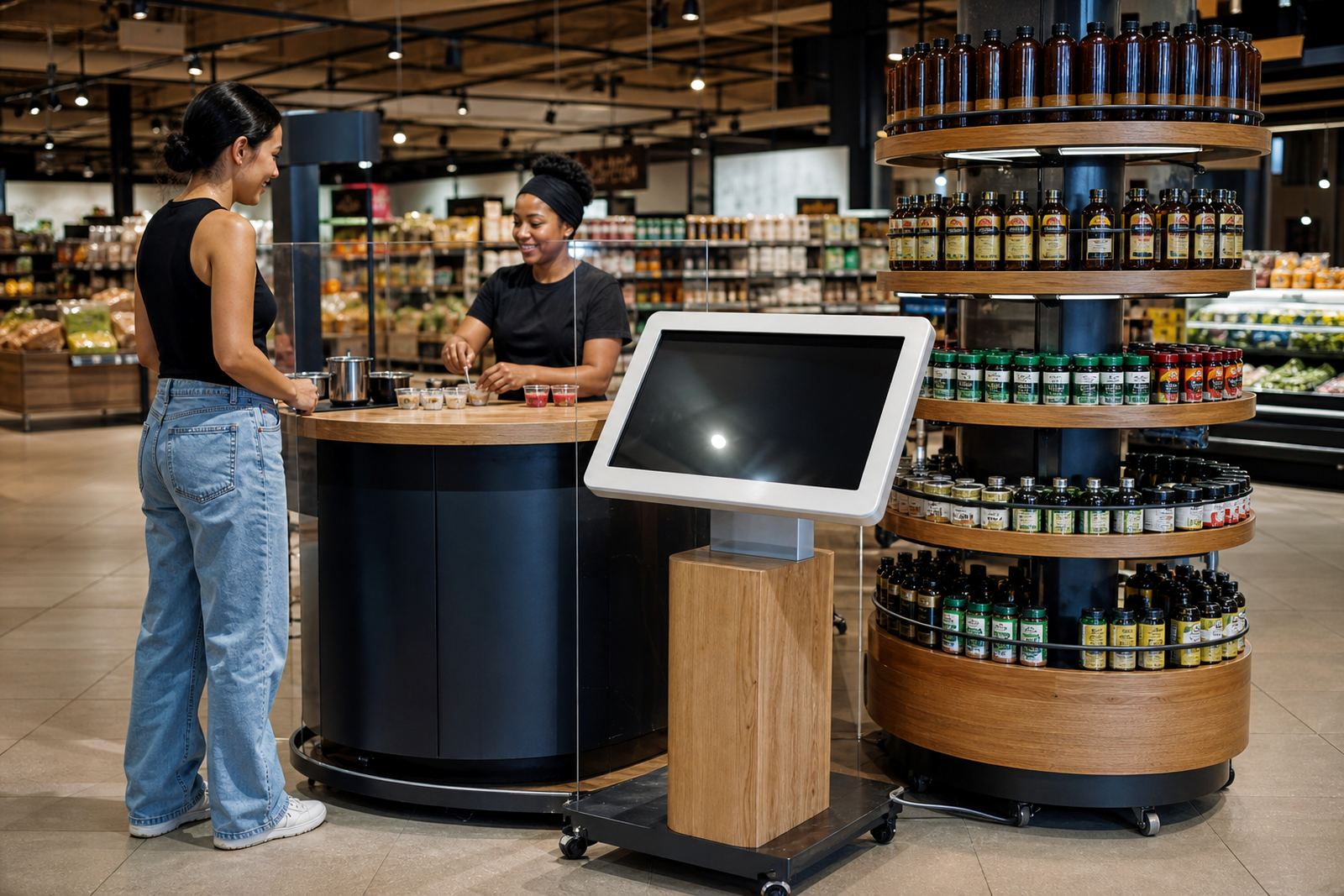
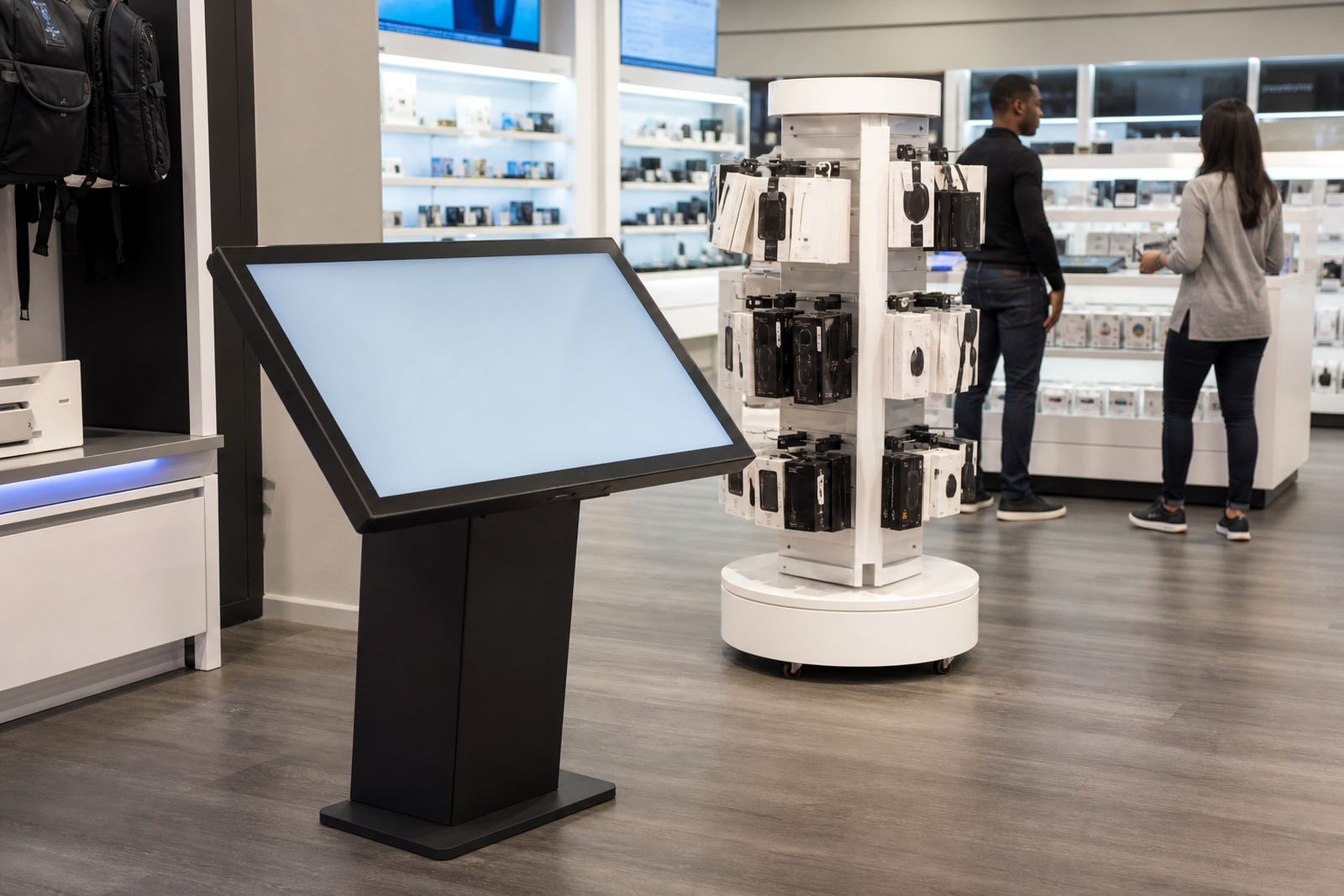
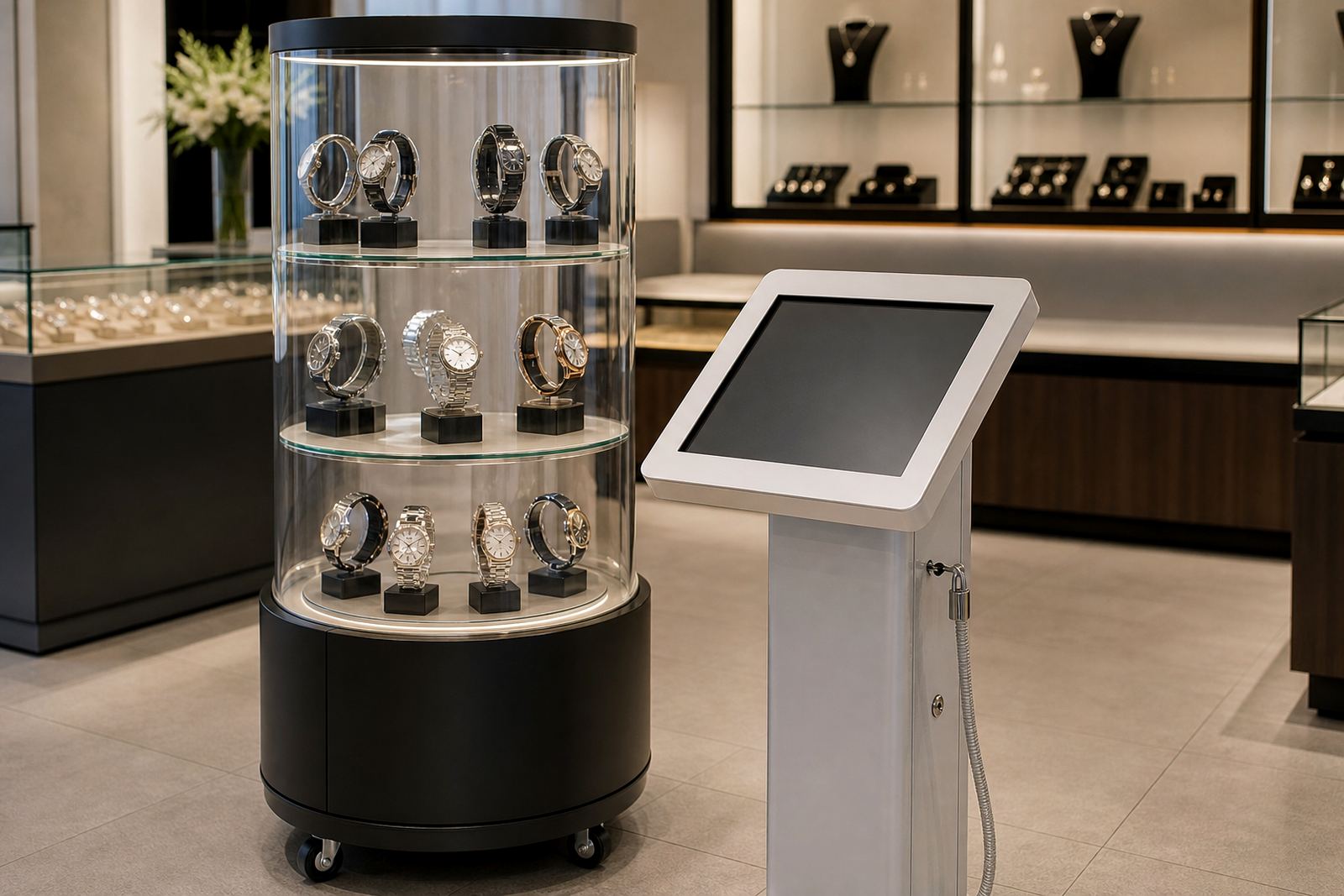
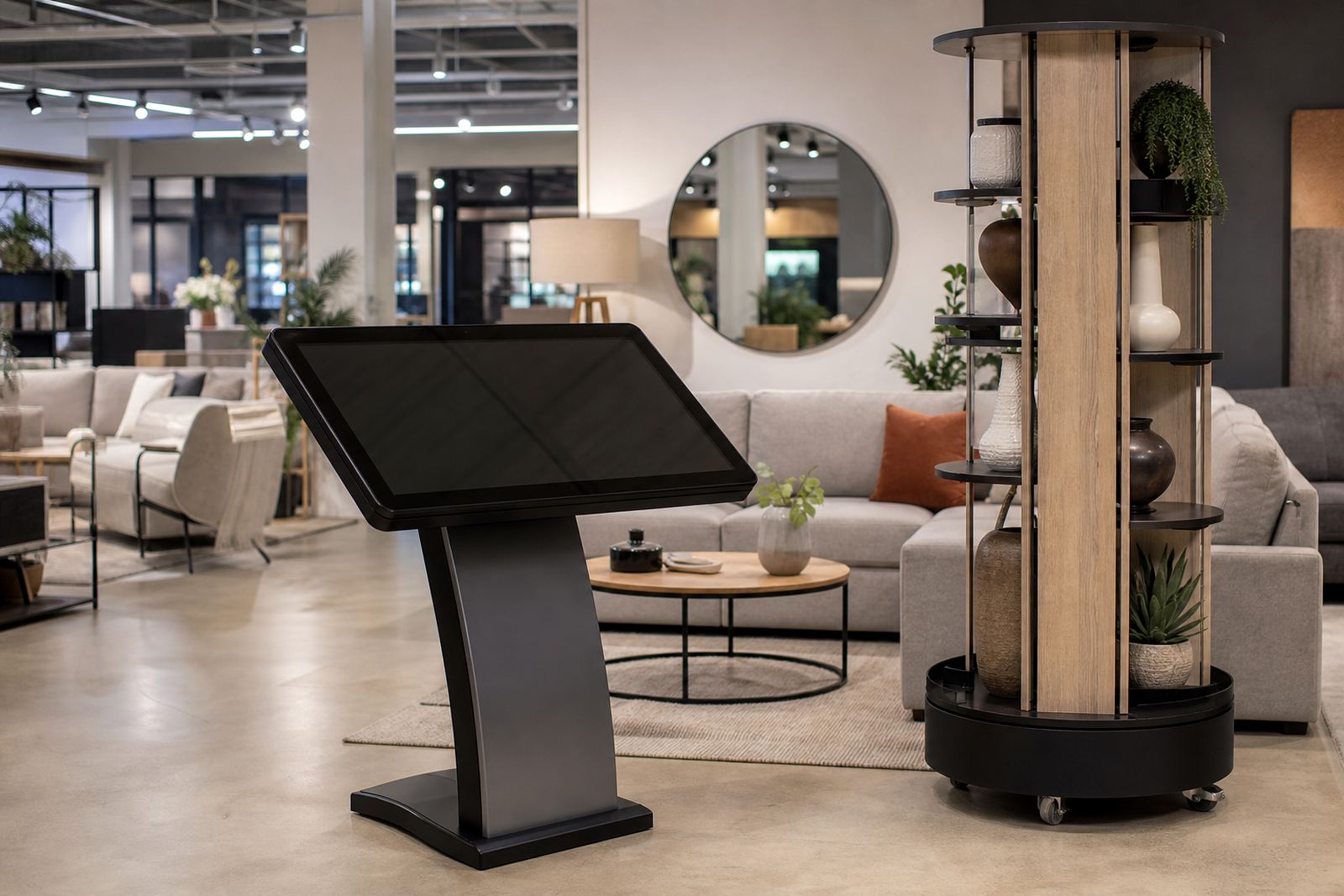
The right set-up depends on the size of the store and how much browsing you want to support. Some retailers only need one kiosk near the entrance, while larger branches place units in the living room, bedroom and office furniture areas. We often recommend a mix of touchscreen kiosks and 360-degree product display stands so shoppers can self-serve and still see the finer product details.
- One or more interactive touchscreen kiosks for browsing ranges and product search
- 360-degree display stands for hero products, fabric swatches or compact accessories
- Mounting frames or floor stands suited to the showroom layout
- Network connection for live content updates where required
- Ups and power protection for load-shedding and voltage dips
- Optional printer or QR handoff for saving product details
In coastal towns like Durban and Cape Town, equipment placement needs care because humidity and salt air can shorten the life of poorly protected hardware. In Gauteng, dust and aircon conditions still need regular cleaning so the screen remains responsive and the display looks professional.
How to plan the layout before installation
A good showroom kiosk should be easy to find but not block the natural flow of customers. Place it where shoppers pause already, such as near the entrance, beside a main range, or close to the cashier point. Avoid tucking it behind a tall display unit where customers need to look around corners just to reach it.
We usually start with a site assessment. That helps us check floor space, power points, wall strength, network coverage and whether the branch has enough room for safe cable routing. In a midrand showroom or a suburban branch in Centurion, the layout can look fine on paper but still fail if the kiosk sits in a narrow aisle or near direct sunlight. Glare on the screen is a common issue and it causes slow use and frustration.
Staff training matters too. If the team knows how to update content, reset the device and help a customer through the first few taps, the kiosk becomes part of the sales process instead of just another screen. Megan from project coordination usually works with the branch team to make sure the handover is practical, not rushed.
Common mistakes furniture retailers make
One of the biggest mistakes is loading too much content onto one screen. If every product, promotion and policy sits in the same menu, shoppers lose interest. Keep the journey simple: browse category, choose product, view finish, then compare sizes or room sets. That works far better than a cluttered menu with too many clicks.
Another mistake is treating the kiosk like a poster. A screen in a showroom must do more than show pictures. It needs current prices or stock notes, useful filters and enough detail to answer basic questions before a salesperson steps in. Without that, staff still end up repeating the same information all day.
- Do not place the kiosk in a dark corner where customers miss it
- Do not rely on one power point without backup during load-shedding
- Do not use very small text for dimensions or care instructions
- Do not ignore cleaning needs in high dust or humid areas
- Do not forget to train relief staff and weekend staff too
We also see branches skip preventative servicing until something fails. A loose cable, dirty fan or damaged touchscreen can stop use completely, and that costs more than a planned check. A small repair now is usually better than replacing a whole unit later.
Budget ranges for showroom kiosk projects
Budgets vary depending on screen size, stand type, branding, software setup and whether you need more than one unit. A basic showroom kiosk for a single branch can start from about R35 000 to R60 000. Mid-range set-ups with stronger branding, custom layout work and better protection for power interruptions often sit between R60 000 and R120 000.
Larger showroom projects with several kiosks, network integration, content loading and ongoing support retainers can move above R150 000, especially if the retailer wants multiple branches supplied at once. A 360-degree product display stand is usually priced separately depending on size, finish and the type of product being shown. It is wise to budget for installation, software configuration and training from the start, not as extras added later.
For chain stores, the real saving comes from consistency. If each branch uses the same structure, staff training is simpler and customers get the same experience in Johannesburg, Pretoria or Cape Town. That makes rollouts easier and avoids the usual mess of one store doing things differently from the next.
Support for multi-branch furniture retailers
iTouch 360 supports retailers from our Midrand base and works with branches in Johannesburg, Pretoria, Sandton, Centurion, Cape Town, Durban and Bloemfontein. We handle delivery installation, software configuration, content loading, network integration, fault repairs and parts replacement where needed. That matters for furniture retailers who want one supplier to manage the full roll-out, not several contractors chasing one another.
Our team includes Sibusiso Mthembu as Managing Director, with Lerato Khumalo in operations, Johan van Wyk on technical direction, Anele Dlamini on retail solutions, Megan Naidoo on project coordination, Thabo Molefe on installation and Zanele Mokoena on client support. The branch team can reach us through the enquiry form on our contact page when they need a new showroom set-up or support on an existing unit.
For furniture showrooms, the goal is simple: help shoppers choose faster, understand the range better and leave with confidence. A good kiosk does that quietly in the background, without getting in the way of the products on display.