
What our fault repairs cover
Our fault repair service covers the technical issues that interrupt day-to-day retail use, from intermittent power loss and touch response problems to display rotation faults and software errors. We work on interactive touchscreen kiosks and 360 degree product display stands used in stores, malls and showroom spaces across Gauteng, the Western Cape, KwaZulu-Natal and the Free State.
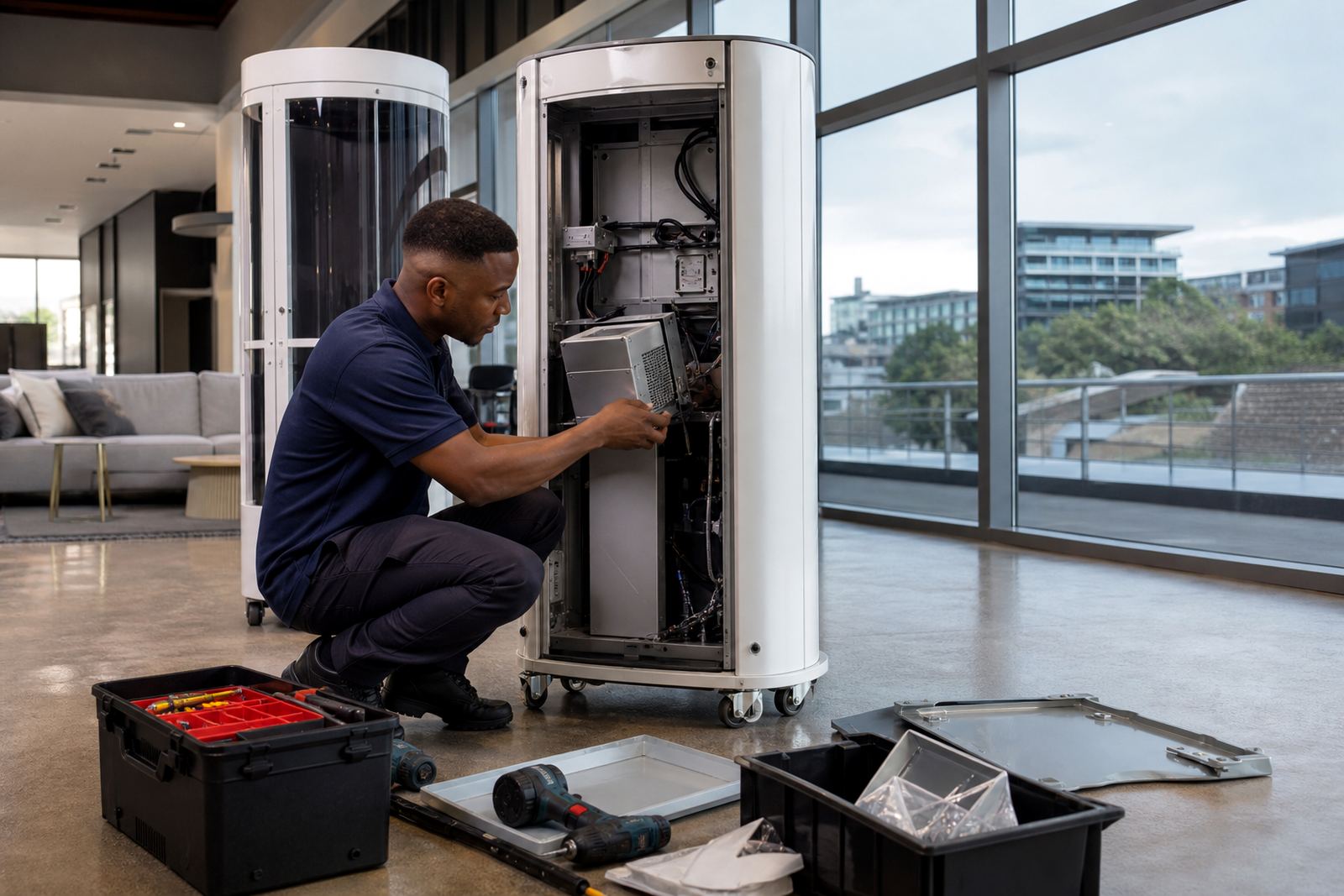
Typical issues include damaged touch panels, failing power supplies, loose internal cabling, damaged data ports, broken motors, worn bearings, software corruption, screen backlight faults and network dropouts. In coastal locations like Durban and Cape Town, we also see humidity related corrosion more often, so we check connectors and internal boards carefully for moisture damage.
- Touchscreen not responding or responding slowly
- Screen flicker, blank display or image distortion
- Motor noise, irregular rotation or no movement
- Power faults after load-shedding or surges
- Network or content loading errors
- Physical wear from constant customer use
How we diagnose faults on site
We start with a structured fault check so the real problem is found first time, instead of swapping parts blindly. The technician looks at the unit's power feed, internal protection components, control boards, touch interface, display hardware and software settings. If the unit is connected to store Wi-Fi or a local network, we also check configuration and signal stability.
For active retail spaces, we try to isolate the fault while keeping disruption low. That can mean testing during quieter trading hours, swapping in a temporary component, or moving the unit out of customer flow for a short period. If the fault is linked to site conditions, like unstable power or poor ventilation, we will explain that clearly and give practical steps for prevention.
- Visual inspection and fault history review
- Electrical and signal testing
- Component-level checks where possible
- Software and configuration review
- Clear report on repair options before work continues
Repair workflow from callout to handover
Our process is kept simple for store managers and maintenance teams. Once the fault is logged through the enquiry form, we arrange assessment, confirm the likely issue and plan the next step. Some faults are repaired on site, while others need workshop repair or parts replacement if the damage is more extensive.
After repair, the unit is tested under normal operating conditions. For touchscreen kiosks that means checking display brightness, touch accuracy, menu response and any connected software functions. For 360 degree product stands, we test rotation speed, load balance and start-stop control so the stand runs correctly under real product weight.
- Fault logged and service slot arranged
- Assessment on site or at our support base
- Repair quotation and approval
- Repair, replacement or software correction
- Final testing and handover with notes
Turnaround times in retail environments
Turnaround depends on the fault type and whether the unit needs a specialist part. Simple issues such as loose wiring, a settings reset or minor hardware replacement can often be handled quickly. More involved repairs, especially when boards, motors or touch assemblies need replacement, may take longer if a part has to be sourced or matched to the unit.
For retailers in Johannesburg, Pretoria, Midrand and Sandton, we prioritise fast response because those stores often rely on the unit daily for product education. In Cape Town, Durban and Bloemfontein, we plan around site access, courier time and store trading hours to reduce delays. If a repair will take more than one visit, we say so upfront and keep the store informed.
- Minor adjustments and resets: same day where possible
- Common component swaps: usually within a short service window
- Board, motor or display replacements: dependent on part availability
- Software and network faults: often fixed during the first visit
Pricing that fits the fault, not guesswork
We price fault repairs according to the actual work required. That keeps costs fair for stores that need a quick fix and for sites where the issue is more complex. The final quote normally considers the callout area, diagnosis time, labour, parts, transport and any after-hours access requirements. For sites in busy malls or where work must happen before trading starts, access planning may affect the price.
We do not charge a store for repairs it does not need. If the fault is caused by a replaceable cable or connector, we recommend that first rather than replacing larger assemblies. Where multiple units are on the floor, we can assess them together so the retailer gets a clearer cost picture and avoids repeat callouts.
- Transparent diagnosis before repair work starts
- Labour and parts quoted separately where practical
- Bulk service options for multi-site retailers
- Preventative recommendations included after repair
Maintenance intervals that reduce repeat faults
Fault repairs work best when they are followed by regular maintenance. For busy retail environments, we normally recommend a service check every 6 to 12 months, depending on traffic, dust levels and the amount of daily use. Coastal stores may need more frequent inspections because salt air and humidity can shorten the life of connectors, bearings and exposed metal parts.
Preventative checks help catch early wear before it becomes a shutdown. We look at cable strain, fan operation, screen cleanliness, mounting stability, software updates, motor wear and power protection. In areas affected by load-shedding, we also recommend checking surge protection and safe shutdown settings, because repeated power interruptions can damage both displays and control systems.
- 6 month checks for high traffic stores
- 12 month checks for lower use sites
- More frequent checks near the coast
- Extra attention after repeated power interruptions
- Combined maintenance for multiple branches available
Key facts
| Service type | Fault diagnosis and repair for interactive kiosks and 360 degree product display stands |
|---|---|
| Coverage | Midrand, Johannesburg, Pretoria, Centurion, Sandton, Cape Town, Durban and Bloemfontein |
| Typical issues | Touch failure, screen faults, motor issues, power problems, software errors and network setup faults |
| Common unit sizes | Floor standing units from 1.2 m to 2.1 m high, with display platforms sized to suit product load |
| Power and integration | Single phase retail supply, surge protection, local network and content control checks |
| Maintenance interval | Every 6 to 12 months, with shorter intervals for high traffic or coastal sites |